# package main
import (
 "bytes"
 "crypto/sha256"
 "encoding/binary"
 "fmt"
 "log"
 "github.com/miekg/pkcs11"
)
const (
 pin = "87654321"
)
var ()
func main() {
 // Init PKCS11
 p := pkcs11.New("/opt/utimaco/lib/libcs_pkcs11_R3.so")
 err := p.Initialize()
 if err != nil {
 panic(err)
 }
 defer p.Destroy()
 defer p.Finalize()
 slots, err := p.GetSlotList(true)
 if err != nil {
 panic(err)
 }
 session, err := p.OpenSession(slots[0],
pkcs11.CKF_SERIAL_SESSION|pkcs11.CKF_RW_SESSION)
if err != nil {
 panic(err)
 }
 defer p.CloseSession(session)
 err = p.Login(session, pkcs11.CKU_USER, pin)
 if err != nil {
 panic(err)
 }
 defer p.Logout(session)
 info, err := p.GetInfo()
 if err != nil {
 panic(err)
 }
 fmt.Printf("CryptokiVersion.Major %v", info.CryptokiVersion.Major)
 fmt.Println()
 buf := new(bytes.Buffer)
 buf = new(bytes.Buffer)
 var num uint16 = 1
 num = 1
 err = binary.Write(buf, binary.LittleEndian, num)
 if err != nil {
 log.Fatalf("binary.Write failed: %v", err)
 }
 pubID := buf.Bytes()
 buf = new(bytes.Buffer)
 num = 2
 err = binary.Write(buf, binary.LittleEndian, num)
 if err != nil {
 log.Fatalf("binary.Write failed: %v", err)
 }
 privID := buf.Bytes()
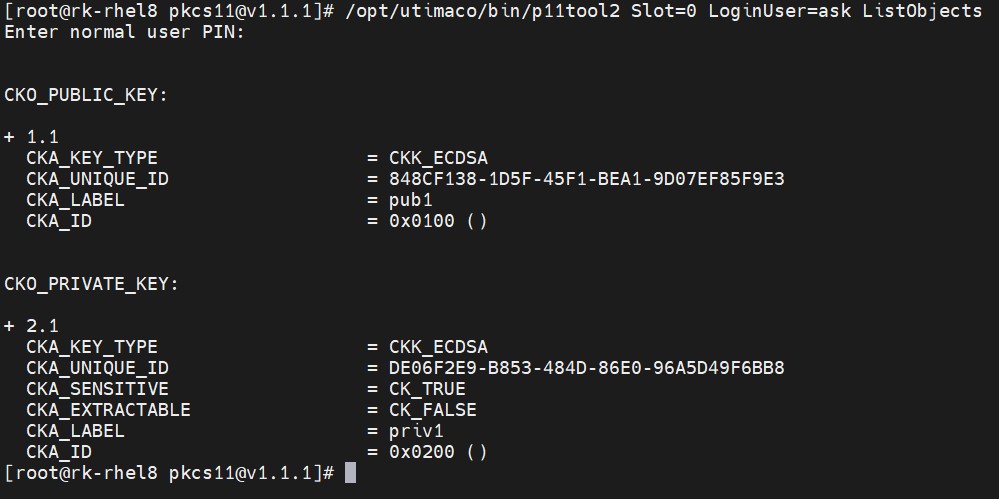
 publicKeyTemplate := []*pkcs11.Attribute{
 pkcs11.NewAttribute(pkcs11.CKA_CLASS, pkcs11.CKO_PUBLIC_KEY),
 pkcs11.NewAttribute(pkcs11.CKA_KEY_TYPE, pkcs11.CKK_ECDSA),
 pkcs11.NewAttribute(pkcs11.CKA_TOKEN, true),
 pkcs11.NewAttribute(pkcs11.CKA_VERIFY, true),
 pkcs11.NewAttribute(pkcs11.CKA_PRIVATE, true),
 pkcs11.NewAttribute(pkcs11.CKA_ENCRYPT, true),
 pkcs11.NewAttribute(pkcs11.CKA_WRAP, false),
 pkcs11.NewAttribute(pkcs11.CKA_LABEL, "pub1"),
 pkcs11.NewAttribute(pkcs11.CKA_ID, pubID),
 pkcs11.NewAttribute(pkcs11.CKA_EC_PARAMS, []byte{0x06, 0x08,
0x2a, 0x86, 0x48, 0xce, 0x3d, 0x03, 0x01, 0x07}),
 }
 privateKeyTemplate := []*pkcs11.Attribute{
 pkcs11.NewAttribute(pkcs11.CKA_CLASS, pkcs11.CKO_PRIVATE_KEY),
 pkcs11.NewAttribute(pkcs11.CKA_KEY_TYPE, pkcs11.CKK_ECDSA),
 pkcs11.NewAttribute(pkcs11.CKA_TOKEN, true),
 pkcs11.NewAttribute(pkcs11.CKA_SIGN, true),
 pkcs11.NewAttribute(pkcs11.CKA_DECRYPT, true),
 pkcs11.NewAttribute(pkcs11.CKA_LABEL, "priv1"),
 pkcs11.NewAttribute(pkcs11.CKA_PRIVATE, true),
 pkcs11.NewAttribute(pkcs11.CKA_SENSITIVE, true),
 pkcs11.NewAttribute(pkcs11.CKA_WRAP_WITH_TRUSTED, false),
 pkcs11.NewAttribute(pkcs11.CKA_UNWRAP, false),
 pkcs11.NewAttribute(pkcs11.CKA_EXTRACTABLE, false),
 pkcs11.NewAttribute(pkcs11.CKA_ID, privID),
 }
 pbk, pvk, err := p.GenerateKeyPair(session,

[]*pkcs11.Mechanism{pkcs11.NewMechanism(pkcs11.CKM_ECDSA_KEY_PAIR_GEN, nil)},
 publicKeyTemplate, privateKeyTemplate)
 _ = pvk
 _ = pbk
 if err != nil {
 log.Fatalf("failed to generate exportable keypair: %s\n", err)
 }
 // Signing
 msg := []byte("foo")
 digest := sha256.Sum256(msg)
 err = p.SignInit(session,
[]*pkcs11.Mechanism{pkcs11.NewMechanism(pkcs11.CKM_ECDSA_SHA1, nil)}, pvk)
 sig, err := p.Sign(session, msg)
 // Verification
  err = p.VerifyInit(session,
[]*pkcs11.Mechanism{pkcs11.NewMechanism(pkcs11.CKM_ECDSA_SHA1, nil)}, pbk)
 err = p.Verify(session, digest[:], sig)
}